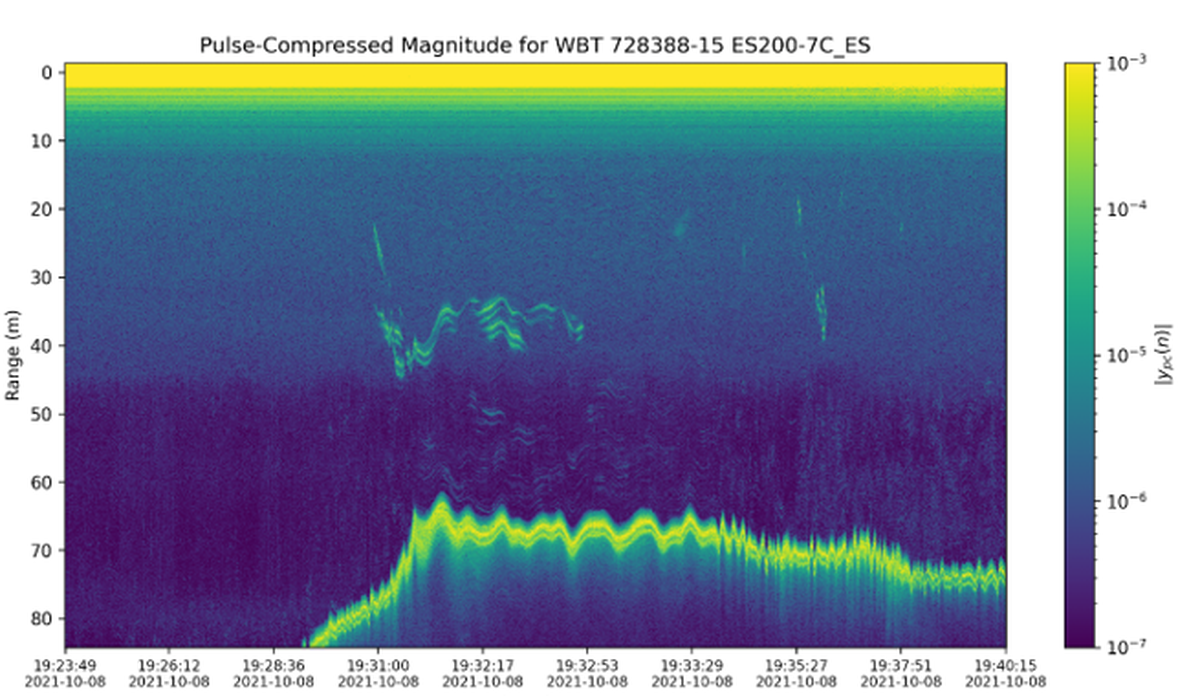
Figur 1 Eksempel på ekkogram frå testdatasett T2021004 som viser makrellstørje målt med ekkolodda på fiskebåten M. Ytterstad.
Test datasets for broadband echosounders – for development and testing of data processing methods
Here you will find small, handpicked samples from data collections gathered during various cruises and experiments, covering species from herring and cod to bluefin tuna and krill. The datasets were collected using multiple types of echosounder platforms – ranging from research vessels to aquaculture cages – and are perfect for anyone working on developing, testing, or demonstrating data processing methods for broadband acoustics.
Why is this important? Test datasets make it easy to consistently test and compare new methods. They can even be used early in the planning phase of an experiment to set up and test data processing workflows in advance. This saves time and ensures reliable solutions are in place from the start. Until now, the community has lacked a common open resource for benchmarking and testing in this field – now we have created exactly that.
In our scientific article, you can find detailed descriptions of each test dataset, including the purpose, time and location of data collection, species involved and their verification, calibrations, and data characteristics. This ensures you have all the necessary information to make the best use of the datasets.
The datasets are available through the Norwegian Marine Data Centre portal via this DOI link:
https://doi.org/10.21335/NMDC-1713052835
We continuously update the collection with new test datasets, and you will find the updated information on the same page. Additionally, we have published practical Python code and guides on GitHub to help you process the data efficiently:
If you have datasets of your own to share or any questions, we would be happy to collaborate!
Check out the collection – it holds a wealth of exciting and useful data for everyone working with broadband acoustics!
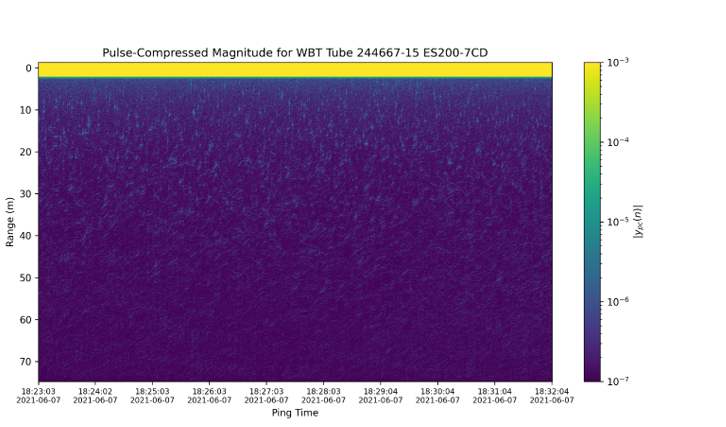
Figure 2 Example of an echogram from test dataset T2021002 showing mesopelagic organisms measured with the towed vehicle MESSOR at 650 m depth.